Paper Trails
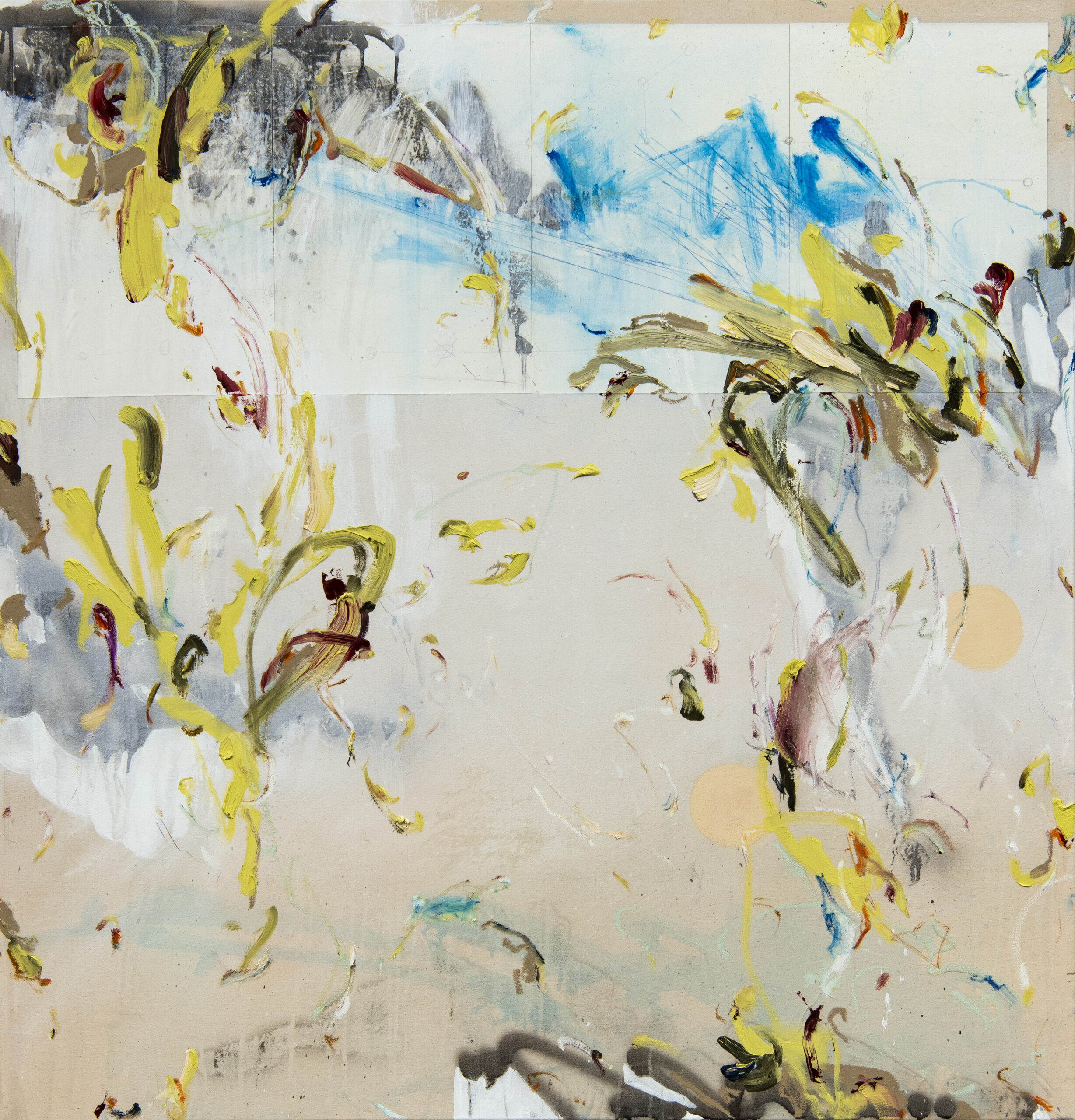
Mikko Paakkonen’s second exhibition at Galleria Halmetoja in Helsinki continues along the same path as his previous solo exhibition in Mänttä. In addition to large-scale paintings, the exhibition is composed of small framed works on paper. Some of the paintings incorporate collage elements. Thematically, the exhibition is in motion: it moves forward without a clearly defined destination. Finding something new is more important than searching for something old. Still, Paakkonen paints paths into visual history. His routes do not follow familiar tracks but instead articulate abstraction in ways that produce narratives diverging from those of modernism.
In Paakkonen’s works, an idea becomes concrete as painting manifests itself as surface and pigment. Yet nothing is clearly delineated; paths intersect in the same way as art-historical styles do. The works form a series of documents, recounting the chain of events Paakkonen has had to live through in order to make this exhibition. The works on paper function as keys to the world of the large paintings. The working process leaves behind a trail of paper. Often the boundary between a sketch and a finished work is blurred, and one work may serve as a sketch for the next.
Paakkonen has also partially returned to earlier modes of working. The exhibition carries a spirit reminiscent of his two early exhibitions at ARTag Gallery. Some of the works once again dare to trust in gesture and refer more directly to street art. Concrete visual traces—such as torn posters and defaced maps—form one possible context for works that are, in practice, abstract. At the same time, metaphor runs alongside materiality. The layered nature of urban space entails a continuous process of disappearance: a new poster is pasted over the old, an unauthorized work is washed off a wall, and what remains is the ghost of the image.
The exhibition is embedded in a moment when people’s attachment to place is weakening, and urban nomadism is no longer only about physical movement but also about the merging of mobility and work made possible by digitalization. This raises questions about cities’ capacity to adapt and about the flexibility of infrastructure in the face of new ways of living. The nomad functions as a metaphor for new forms of identity, movement, and belonging. How people navigate this time is not merely a matter of choice but a phenomenon shaped, for example, by platform economies and rigid urban structures. In Mikko Paakkonen’s works, this movement becomes image.
Veikko Halmetoja, gallerist
Mikko Paakkonen (b. 1990) holds a Master’s degree in Fine Arts from the Academy of Fine Arts, Helsinki. His work has been presented in solo exhibitions in Finland and abroad, as well as in numerous group exhibitions across Finland. Paakkonen’s works are included in the collections of the Saastamoinen Foundation, the Finnish Art Society, Kesko, and several private collections.
Thank you to Finnish Art Society for supporting the artist’s work.
Inquiries: gallery@galleryhalmetoja.com